History
The Dream of a Villa: Glory, Decline and Future

Straddling the late 17th and early 18th centuries, the manufacturing complex of Nuevo Baztán was born thanks to the Navarrese Juan de Goyeneche.

Nuevo Baztán was declared a Historic-Artistic Monument in 1941 and passed through various hands until reaching the present day. On February 26, 1980, it was declared a Historic-Artistic Ensemble and a Site of Cultural Interest, in March 2000.
Is a jewel of the Baroque period, as its urban settlement included the most advanced manufacturing complex of its time, a precursor to the great modernisation and industrialisation of Spain undertaken by the early Bourbon kings. Nuevo Baztán thus became the precedent on which the future Royal Factories that have survived to this day would be based.
Juan de Goyeneche developed the Nuevo Baztán project, providing local and regional labour—Castilians—as well as craftsmen brought from different places both in Spain and across Europe, in order to get his factories up and running.
The construction of a new villa, factories ahead of their time, or the separation of an entire village that even reached the Pope’s ears were just some of the events Nuevo Baztán went through. However, a shift in political and economic ideas and the cessation of production linked to the army put an end to this unique experiment in Spain, leading to the abandonment of the settlement and the palace complex.
History of the Municipality

The success of the new villa
In 1698, Juan de Goyeneche acquired the estate known as Hacienda del Bosque de Acevedo, where some early buildings already existed and which, years later, would become the origin of what would be Nuevo Baztán.
Around 1702, construction began on a residential complex that would later become a large manufacturing and industrial complex. The works continued until 1715, providing premises for the industries he gradually created as a complement to those he already owned—cloth mills—since 1710, in La Olmeda de la Cebolla (today Olmeda de las Fuentes), a municipality located 4 km from Nuevo Baztán.
Goyeneche integrated into this manufacturing and industrial complex a series of buildings to house the workers who joined his various factories over the years: factories producing textiles, leather goods, silk, soap, candles, shoes and paper. Special mention should be made of the fine glass factory, as it was the most important of them all, although it had a very short life due, among other causes, to the depletion of fuel from the forest mass of the nearby mountains. He eventually moved this factory to Villanueva de Alcorón, in Guadalajara.
Another noteworthy building was the so-called “house of distinction”, better known as the Old Inn, a two-storey building with an interior courtyard intended to accommodate people who came to the industrial complex for business reasons, or to lodge families who, coming from the court, spent the cool summers the place offered.


A small but beautiful temple, attached to the main façade of the palace, was built between 1707 and 1710. The sculptor and altarpiece maker José Benito de Churriguera took part in this project, and was the author of the altarpiece of the high altar of this church dedicated to Saint Francis Xavier.
It was in October 1723, by papal bull of Innocent XIII and after many years of litigation between Goyeneche and the parish priest, that ecclesiastical autonomy was granted to the church of Nuevo Baztán, becoming an independent parish—thus proclaiming the founding of Nuevo Baztán.
Juan de Goyeneche designed the architectural complex in the style that Colbert had built in the France of Louis XIV, and developed Nuevo Baztán by bringing in people originally from different parts of Spain as well as French and Flemish craftsmen. The urban settlement included the most advanced industrial complex of its time, a precursor to the great task of modernisation and industrialisation of Spain undertaken by the early Bourbons.
After the death of Don Juan de Goyeneche in 1735, management of this industrial complex was taken over by his two sons: first Don Francisco Javier de Goyeneche y Balanza, who died in 1748, and then Francisco Miguel de Goyeneche y Balanza. With his death in 1762, the decline of the great project began with the definitive end of tax exemptions, leading to the closure of the last hat, cloth and paper factories. Thus, in 1778, the industrial project of Nuevo Baztán came to an end.
Texts prepared by the Association for the Historic Heritage of Nuevo Baztán
Learn more about the History of our Municipality through the official website of the Association for the Historic Heritage of Nuevo Baztán and its repository of historical documents.
Stagnation and revival of Nuevo Baztán
After the production halt and the closure of the last factories, the population of old Nuevo Baztán fell sharply, with only a handful of families remaining, devoted to livestock and agriculture between the core of Nuevo Baztán and MonteAcevedo.
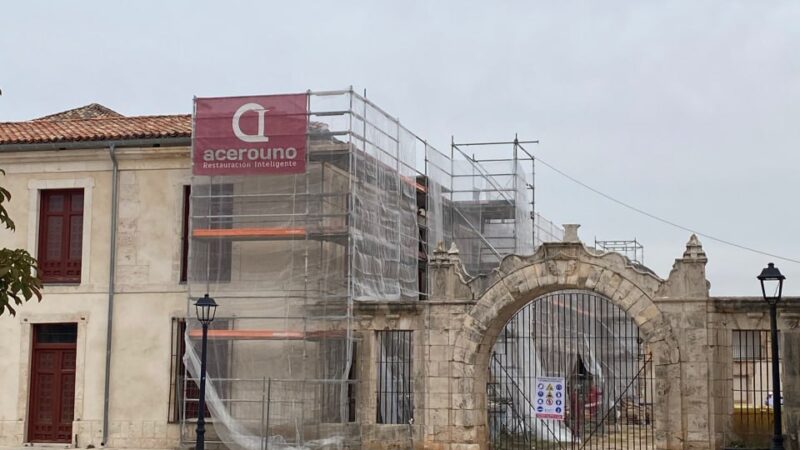
With the historic centre covered in earth and rubble, the recovery of this pre-Enlightenment town began on October 26, 1941. On that date, the Official State Gazette published the declaration of Historic-Artistic Monument for the ensemble made up of the Palace, the Church and the two nearby squares of Nuevo Baztán. As a result, the ensemble became subject to the laws on Artistic and Monumental Heritage under the guardianship of the Spanish State, and this distinctive location began to be revalued.
In 1965, the first residential developments began to take shape in the town’s expansion area. The new project, initially called Ciudad de las Américas, would eventually become today’s Eurovillas. This new centre, known as one of the largest housing developments in 1990s Europe, would drive the repopulation of the municipality.
Alongside this major project, future developments would appear, such as El Mirador de Nuevo Baztán in an old bird-breeding area; Las Villas, the second largest, in a former agricultural zone and vineyards of the palace’s old wineries; and finally Monte Acevedo in 1974, the most modern in the area.
Finally, on February 26, 1980, the historic centre was declared a Historic-Artistic Ensemble, which would ultimately become the property of the Autonomous Community of Madrid almost a decade later.